
Drums of scheduled waste: what the storage rules ask of a small factory, and what a lapse costs since 2024
Penang’s environment department put six factories up for compounds over notice, containers and labels. What the 2005 regulations and the DOE’s storage guideline require, and how far the 2024 amendments raised the penalties.
Six factories in the Juru River basin in Penang were recommended for compounds after inspections from 14 to 18 September, and the suspected breaches the Penang Department of Environment (DOE) named are the plainest parts of the scheduled waste rules: not notifying new waste within 30 days, not storing it in durable containers able to prevent spills or leaks, and not labelling it. The department inspected 14 factories and gave the other eight directive notices, Bernama reported on 7 October.
The three breaches concern notice, containers and labels, the kind of thing that slides when the waste store is a corner of the loading bay. On our reading of the Act as amended in 2024, the most a court can fine for any one of them rose from RM10,000 to RM250,000 in July 2024, and the most the DOE can accept to settle one by compound rose from RM2,000 to RM125,000.
What the 2005 regulations ask of a factory that makes scheduled waste
A factory that produces scheduled waste must notify the DOE, keep the waste in sound and closed containers, label it, send it out within 180 days and keep records. The duties sit in the Environmental Quality (Scheduled Wastes) Regulations 2005, in force since 15 August 2005, which the DOE publishes in Malay with their 2007 amendment.
Scheduled waste is anything in the categories of the regulations’ First Schedule, and a workshop meets several of the listed categories without trying: spent lubricating and hydraulic oil (SW 305 and SW 306), non-halogenated solvent waste (SW 322), sludge containing metals (SW 204), contaminated containers (SW 409), and contaminated rags, paper or filters (SW 410).
- Notify within 30 days of generating any new category and quantity of scheduled waste (regulation 3).
- Use containers that hold: suited to the waste, durable, able to stop spills or leaks, and closed except when adding or removing waste (regulation 9(1) and 9(3)).
- Keep incompatible wastes apart, in separate containers within separate secondary containment areas (regulation 9(2)).
- Move it within 180 days, and keep no more than 20 tonnes on site without written approval. The Director General can order waste sent out at any time (regulation 9(5) to 9(7)).
- Label every container with the date the waste was first generated, the generator’s name, address and telephone number, the hazard label and the waste code (regulation 10).
- Keep an inventory in the Fifth Schedule format covering three years from generation, and train everyone who handles, labels, stores or moves the waste or responds to a spill (regulations 11 and 15).
Factories in Sabah and Sarawak should also check with their state. The DOE said in a notice of 26 May 2026 that a bill had passed letting the minister suspend the Act in whole or in part in any part of Malaysia, so that those two states can manage scheduled waste under their own laws, and gave no date for that.
What the DOE’s storage guideline adds, and where a spill pallet fits
The DOE’s storage guideline turns “store it properly” into a floor, a roof, a bund and a pallet layout, and regulation 9(4) points straight to it by requiring storage areas to be designed, built and maintained in line with guidelines set by the Director General. The Guidelines for Packaging, Labelling and Storage of Scheduled Wastes in Malaysia, with a foreword signed by the Director General in January 2014, set out those criteria.
For the store itself, section 5.2 of the guideline asks for:
- a concrete or similarly lined floor free of cracks and gaps, a roof, a fence, restricted access and “DANGER” signs;
- a concrete dike or equivalent around the whole store, holding 110% of the largest container, with no opening, graded to a sump and kept free of rainwater;
- ventilation for volatile wastes, separate compartments for incompatible wastes, fire-fighting equipment, a spill kit and compliance with the Fire and Rescue Department’s requirements;
- room for 25% more than the most waste the premises generates, over no more than 180 days.
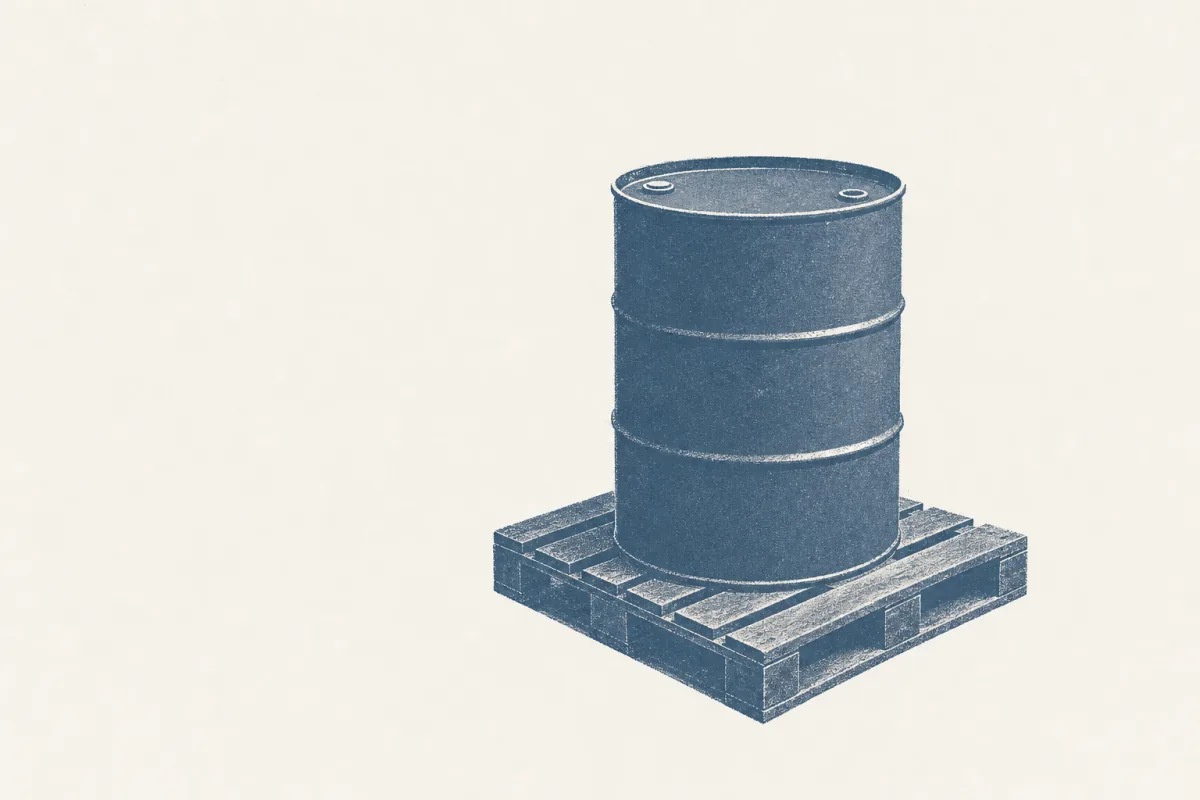
For the containers, section 7 of the guideline puts drums on pallets, no more than four to a standard pallet, stacked at most two tiers high without crates, in rows two pallets wide, and upright.
The guideline defines secondary containment as a liquid-tight barrier that holds what escapes from a container. Inside a bunded store, a pallet with its own sump gives one group of drums a barrier of its own, which is one way to keep incompatible liquids apart. Value-Tech, a Selangor supplier of industrial safety equipment, lists spill containment pallet models for one, two and four drums. We found no DOE statement on whether a pallet sump counts as a separate secondary containment area, so ask your state DOE office before relying on one in place of a built compartment. The dike around the store is a separate requirement.
What a lapse can cost since July 2024
The penalties are the part that changed. The Environmental Quality (Amendment) Act 2024, published in the Gazette on 6 June 2024 as Act A1712, raised fines across the Environmental Quality Act 1974, and the DOE said the tougher penalties took effect on 7 July 2024, The Star reported that October.
The 2005 regulations set no penalty of their own, so on our reading a breach falls under section 41 of the Act, the general penalty for offences that carry none. Act A1712 raised that from a fine of up to RM10,000 to a fine of RM5,000 to RM250,000, leaving the prison term of up to two years as it was, as Lee Hishammuddin Allen & Gledhill’s note on the bill also sets out.
| What went wrong | Where the penalty sits | Before 7 July 2024 | Since 7 July 2024 |
|---|---|---|---|
| No notice of new waste, unsuitable or open containers, incompatible wastes together, waste past 180 days or over 20 tonnes, missing labels (regulations 3, 9 and 10) | Section 41, the general penalty | Fine up to RM10,000, or up to 2 years in prison, or both | Fine of RM5,000 to RM250,000, or up to 2 years in prison, or both |
| Settling any of those by compound (regulation 16) | Section 45 | Up to RM2,000 | Up to half the maximum fine: RM125,000, our calculation |
| Placing, depositing or disposing of scheduled waste anywhere but prescribed premises | Section 34B | Fine up to RM500,000; prison up to 5 years | Prison up to 5 years, and a fine of RM100,000 to RM10 million |
The table is our own summary of the Act, Act A1712 and the regulations, not an official one. For section 34B before the amendment, the 2001 text on the DOE’s website makes the prison term optional, while the law firm’s 2024 note describes it as already mandatory, so that cell gives only the maximum fine and the maximum term.
Regulation 16 makes every breach of the 2005 regulations compoundable under section 45, which lets the DOE, with the Public Prosecutor’s written consent, settle an offence by accepting a sum from the person suspected of it. That sum was capped at RM2,000 under the old section 45 and is now capped at half the maximum fine. These are ceilings: we found no published DOE schedule of what it charges in a given case.
The heaviest penalty sits in section 34B, which bars placing, depositing or disposing of scheduled waste on land or into Malaysian waters except at prescribed premises. The DOE’s Director General at the time, Wan Abdul Latiff Wan Jaffar, told The Star in October 2024 that the prison term is mandatory for illegal disposal of scheduled waste. Section 43 of the Act, in the text on the DOE’s website, adds a personal edge: when a company commits an offence under the Act or its regulations, a director or manager at the time is deemed guilty unless he proves it happened without his consent or connivance and that he took all due care to prevent it.
The same store falls under workplace safety law too. Section 15 of the Occupational Safety and Health Act 1994 makes it an employer’s duty to arrange, so far as is practicable, for safety in the “handling, storage and transport of plant and substances”. Since its 2022 amendments came into operation on 1 June 2024, a breach carries a fine of up to RM500,000, up from RM50,000, or up to two years in prison, or both, under section 19 of the updated text DOSH publishes.
For scale, the DOE said it prosecuted 148 offences of all kinds from January to April 2026, with court fines totalling RM4.59 million, Free Malaysia Today reported.
A worked example: two drums a month
In a small factory’s store, the 180-day clock can bite long before the 20-tonne cap does. Take a workshop that fills two 200-litre drums of spent solvent a month and has a second waste stream incompatible with it; the figures are illustrative and our own arithmetic from the regulations and the guideline.
- The clock. 180 days is about six months, so a workshop that waits for the limit can have up to 12 drums on site before collection.
- The weight. Assuming, for simplicity, a kilogram a litre, 12 drums come to about 2.4 tonnes, far below the 20-tonne cap.
- The floor space. At four drums a pallet, 12 drums need three pallets. The guideline’s 25% margin takes that to 15 drum places, or four pallets, in rows two pallets wide.
- The bund. The largest container is a 200-litre drum, so the dike around the store must hold at least 220 litres, 110% of it.
- The second stream. It goes in its own containers and its own containment area, not on the solvent’s sump.
We have not priced the build-out: slabs, roofs, dikes and pallets vary with the site and we found no official cost benchmark, so get two quotes and set them against the ceilings in the table. If the work needs a loan, what SME money costs in 2027 sets out the schemes and rates.
What to check before an inspector does
Five checks cover what the Penang inspections named and most of what the regulations ask, and none needs a contractor to start.
- Notifications. List every waste stream on site and confirm each was notified to the DOE within 30 days of first being generated. A new process or chemical can mean a new category (regulation 3).
- Labels. Every container shows the date the waste was first generated, your company’s name, address and telephone number, the hazard label and the waste code (regulation 10).
- The oldest drum. Find the earliest date on any label. If it is close to 180 days, book a collection with a contractor licensed by the DOE (regulations 2 and 9(5)).
- Containment. Lids shut, no weeping drums, incompatible wastes apart, the dike unbroken, the floor free of cracks and the sump clear (regulation 9 and section 5.2 of the guideline).
- Records and people. Keep the inventory, keep your signed copies of each consignment note for at least three years (regulation 12(7)), and record who has been trained (regulation 15).
This is general information on published law, not legal advice. For a specific site, ask your state DOE office or your own adviser.
Sources
- Bernama, Action Taken Against 14 Industrial Premises In Sungai Juru Under ‘Ops Gempur - Penang DOE’, 7 October 2026
- Environmental Quality (Scheduled Wastes) Regulations 2005, P.U.(A) 294/2005 with the 2007 amendment, Malay text published by the Department of Environment, regulations 2, 3, 9, 10, 11, 12, 15 and 16 and the First Schedule
- Department of Environment, Guidelines for Packaging, Labelling and Storage of Scheduled Wastes in Malaysia, foreword dated January 2014, sections 5.2 and 7
- The Star, Tougher Environmental Quality Act have been in effect since July 7, says DOE, 2 October 2024
- Environmental Quality (Amendment) Act 2024 (Act A1712), published in the Gazette on 6 June 2024, sections 22, 24 and 25 (copy hosted by Zul Rafique & Partners)
- Environmental Quality Act 1974 (Act 127), Malay text incorporating amendments to Act A1102/2001, published by the Department of Environment, sections 34B, 41, 43 and 45 before the 2024 amendments
- Lee Hishammuddin Allen & Gledhill, Dewan Negara Passes the Environmental Quality (Amendment) Bill 2023, April 2024
- Occupational Safety and Health Act 1994 (Act 514), updated text as at 1 June 2024, published by DOSH, sections 15 and 19
- Free Malaysia Today, RM4.6mil in fines issued after crackdown on polluters, 28 May 2026
- Department of Environment, Kelulusan Rang Undang-Undang Pindaan Akta Kualiti Alam Sekeliling 1974, 26 May 2026
Published by Malaysia Bisnes. See the masthead for who writes and who publishes this magazine.
See something wrong? Write to the editor through the corrections page. Corrections are noted on the article.